
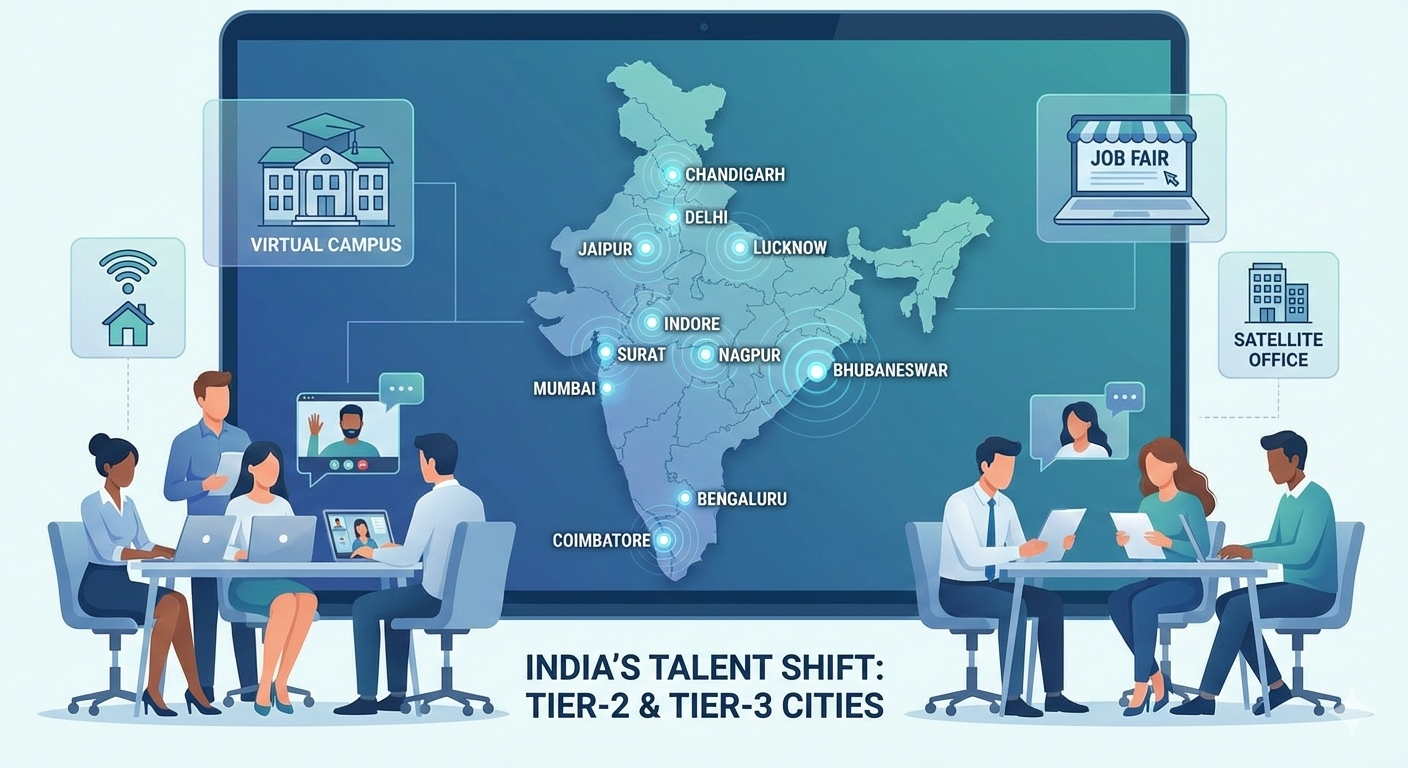
Tier-2 / Tier-3 City Recruiting: Why Talent Map of India Is Leaving Metros
The Indian story of talent is no longer metro centric in 2026. The accelerated infrastructure, reduced prices, better online connection, and local government incentives have propelled hiring forces to Tier-2 and Tier-3 cities. This presents a strategic chance to employers and talent-acquisition teams to access untapped labour markets; it is also a new career opportunity before outside of the megacities.
Keywords to trend (2026): non-metro hiring 2026, tier-2 jobs India, virtual campus recruiting, remote work India 2026, emerging market hiring, talent acquisition tier-2, upskilling non-metro.
The data is telling us (quick snapshot) what.
The epicentre of a big hiring spurt in 2026 was smaller cities, as a number of industry trackers showed that Tier-2 and Tier-3 hiring increased in the double-digit percentage range compared to metros.
The demand is becoming wider than traditional IT jobs to BFSI, retail, manufacturing, healthtech, and AI-related jobs.
Employers and job seekers can do much to mitigate the risk of identity theft, but only if they understand the tactics to implement.<|human|>To the greatest extent, employers and job seekers can reduce the threat of identity theft, though only when they know which tactics to apply.
The reason why talent is moving out of the metros.
Cost & quality of life: Competitive payment packages may be offered by employers and the prices of real estate and operation are lower in non-metros. Employees have an improved work-life balance and are more affordable.
Governmental infrastructure/policy drive Tier 2 and Tier 3 cities are becoming appealing destinations to establish centres and hubs due to state policies and special incentives (GCC policies, industrial corridors, and digital infrastructure programs).
Digital preparedness: Remote work: Broadband and hybrid work structures are widespread so that companies can decentralize teams without reducing productivity.
Unutilized skilled labor: The engineering colleges, polytechnics, and soon to be upskilled gig workers can be used to offer a consistent stream of roles that need not be metro-centric.
What employers ought to do: effective recruitment in the emerging markets.
Online campuses + distant recruiting pipelines.
Conduct virtual campus tours using recorded information sessions, brief skill tests and asynchronous interview sessions so that applicants not in the metro do not need to travel.
Employ regional application landing pages and WhatsApp bots on application flows are easy to use — minimal friction is vital.
Local job fairs and community partnering.
In cooperation with colleges and municipalities, organize local job fairs as a host or sponsor. Introduce condensed onboarding and test centres at the location of the applicants.
Collaborate with local training centers on role-specific boot camps; jointly designed curriculums cut down on time to productivity.
Micro-hubs and satellite centers.
Rather than the entire offices, consider satellite hubs or GCC lite centres: smaller footprints, shared office memberships and flexible seats.
Non-metro talent employer branding.
Localize employer branding. Produce content in local languages, emphasize success stories of staff recruited in other cities and present visible career progression into headquarters.
The referral program: decentralized sources.
Referral programmes Scale up non- metro employees to be brand ambassadors. Appreciate performance-based incentives to draw micro-influencers capable of increasing hiring impetuses.
Upskilling and apprenticeship.
Provide paid apprenticeship, micro-, and certification sponsorships (AI fundamentals, cloud basics, fintech knowledge) to close skill gaps.
Measure & iterate
Refine strategies with track time-to-hire, local retention, upskilling conversion rates, and hiring cost per location.
Opportunities, challenges and a playbook: job seekers.
Opportunities
Fast track career progression: Starting at an early stage in new hubs can also provide a wider range of responsibilities and more rapid promotion.
Improved living conditions: The ability to spend more and reduced travel duration.
Remote roles in large organizations: Large organizations are also creating remote positions that are aimed at non-metro talent.
Challenges
- Skill gaps: It might be necessary to upskill some of the positions- consider short, intensive certification programs.
- Infrastructure variability: Internet infrastructures and local facilities might vary by city.
- Perception & network: Have fewer connections and mentorship programs than metros do - develop connections online.
Create an efficient small portfolio and complete brief project-based courses (AI basics, data handling, digital marketing).
Register on virtual career fairs and local job boards - configure notifications on remote or hybrid jobs.
Get ready to record an asynchronous interview: Have an introduction video of your polished self and a good test environment.
Bargain on relocation allowances, joining bonuses, or home-office allowances in case of move to new city.
Relocate or stay remote? Decision checklist
Where relocation is reasonable: weigh career path, family and social networks, commute and post-local cost-adjusted salary.
Staying remote: ensure career progression map, leader visibility and access to training and mentorship.
HR teams Case studies: Ideas of quick win experiments.
Virtual campus sprint in 48 hours: Shortlist 50 candidates, have them complete two skill micro-tasks and hire 3 on paid trials.
Local bootcamp networks: Turn 10% best bootcamp students into apprentice with 3-month performance review - monitor conversion.
Satellite office pilot: Six months shared office of 25 seats; retention, commute, and hiring conversion.
Final thoughts
The recruiting teams and job seekers that can go everywhere quickly and localize wisely will prevail as the economic activity of India becomes decentralized. Hiring will go hybrid, distributed, and local-first. Test the waters, gauge effectiveness, and expand what works.